Anyone heading up to the prestigious hotel The Dolder Grand along the green slopes of the Adlisberg immediately grasps its relationship with Zurich: the hotel looks down over the city and its lake, with the Alpine chain spread across the background when the air is clear, and yet the centre is just a few minutes away by car, a connection also ensured by the hotel’s own shuttle service. Among the reasons to make the journey, besides those that have long made it a benchmark name in Swiss hospitality, one has recently been added that will particularly interest those who travel in search of unique haute cuisine experiences: since March 2026 it has been possible to dine inside the kitchen of The Restaurant, the two-Michelin-starred gastronomic restaurant entrusted to Heiko Nieder since 2008.
The original design, by the architect
Jacques Gros, dates back to 1899, when the
Dolder Grand Hotel & Curhaus opened as a place for holidays and health cures a short distance from the city; only in the 1920s did it begin operating all year round, and later extensions ended up compromising the symmetrical layout of the complex. Coherence was restored between 2004 and 2008 by the work of
Foster + Partners,
Norman Foster’s first venture into hotel design: the historic building was renovated, bringing to light stucco decorations that had remained hidden for decades, while in place of the volumes added over time two new buildings arose, linear and sinuous, set on either side of the nineteenth-century core as if to protect it, with façades conceived to converse with the birch woods around them. The encounter between the Belle Époque structure and a present-day architectural language, rigorous and measured, is perhaps the most successful feature of the whole, and it returns in the rooms of the Golf Wing, airy and contemporary in taste, as well as in the generous spaces of the conference centre.
The spa, which covers 4,000 square metres, bears the signature of
Sylvia Sepielli: the American designer, who spent more than ten years in Japan, has blended the restraint of Japanese aesthetics with references to the mountain landscape. Indoor and outdoor pools, saunas and Turkish baths, a snow room and spaces for meditation alternate with outdoor terraces offering views of the Alps. The greenery around the hotel completes the picture: the woods crossed by footpaths, the tennis courts and a nine-hole golf course, practically on the hotel’s doorstep.
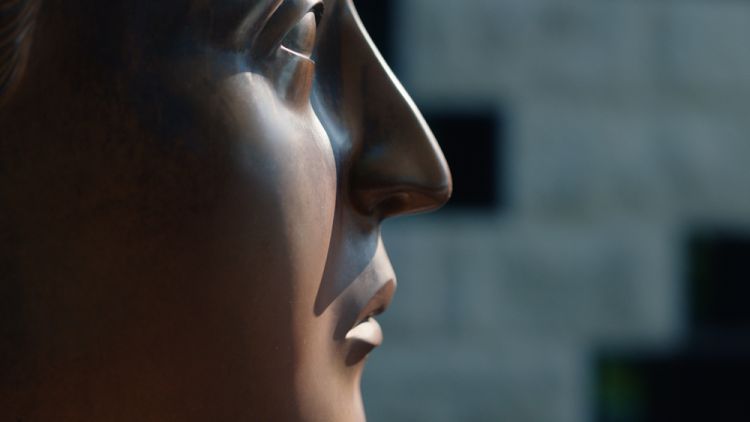
A detail of the work by Fernando Botero
Another element linking the old parts to the new is the art collection of the
Schwarzenbach family, owners of the hotel, who oversee its selection and renew it periodically: more than one hundred works, displayed mostly in areas open to all guests, each with a QR code alongside it for learning more about the artist and the context and for moving freely from one piece to the next. On arrival, the eye is drawn to the sculpture by
Joan Miró next to the vehicle entrance; inside, one may come across “Traveller” by
Duane Hanson, one of the hyperrealist sculptures with which the American artist portrayed ordinary people, while on the way to the wellness area visitors meet “Le Monde” by
Niki de Saint Phalle and
Jean Tinguely and, on the spa’s outdoor terrace, the female figure by
Fernando Botero entitled “Woman with Fruit”. These are twentieth-century works which, often placed in spaces built only a few years ago, find in that very contrast a harmonious setting.
The entire culinary offering is overseen by
Heiko Nieder, the hotel’s Culinary Director. German, born in 1972, he trained in Hamburg at the
Hotel Vier Jahreszeiten and earned his first Michelin star in Bonn in 2004, at
L’Orquivit; four years later he moved to Zurich, where he opened
The Restaurant, today holding two Michelin stars and 19 GaultMillau points. In 2019 GaultMillau named him Chef of the Year, and the Best Chef Awards gave him 2 Knives in both 2024 and 2025. The hotel’s four restaurants, all under his supervision, are joined by several seasonal initiatives, and for ten editions, up to that of 2025,
Nieder conceived and led
The Epicure, a festival that brought some of the world’s most celebrated chefs to the
Dolder.
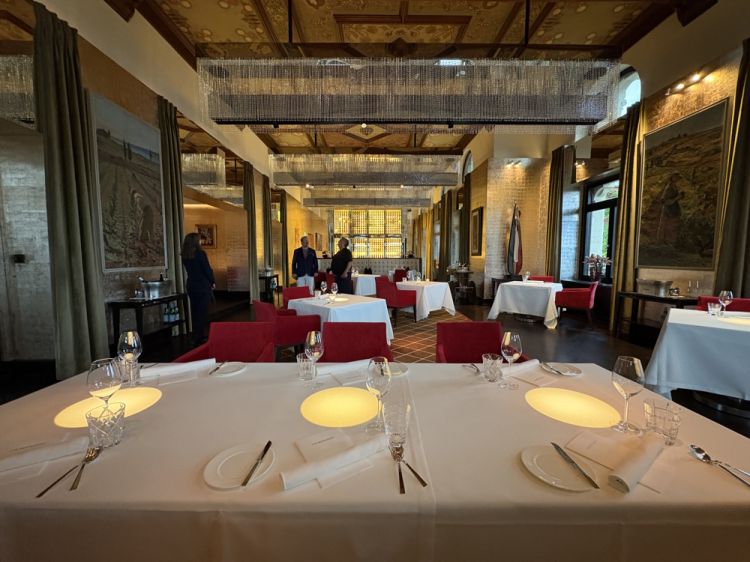
The dining room of The Restaurant
Behind this variety of offerings lies an extensive organisation that guests never see. Beneath the hotel runs a network of tunnels and service passages that connects the different buildings and allows staff to reach every department quickly; along this route are the kitchens of the individual restaurants and those serving banquets and conferences, as well as a pastry workshop devoted entirely to chocolate. This collective work, carried out far from the guests’ eyes, is what makes it possible to meet very different requests and needs.
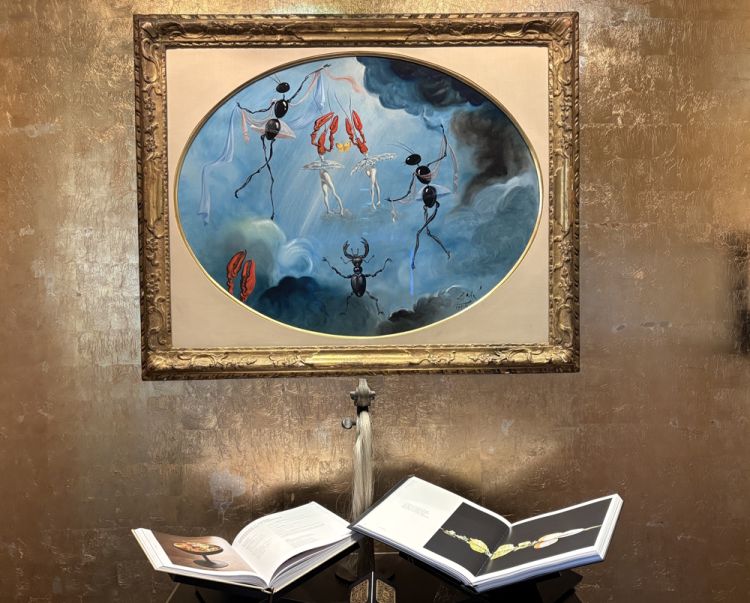
“Femmes métamorphosées – Les sept arts” by Salvador Dalí
One of these kitchens, that of
The Restaurant, normally closed to the public, is home to the
Chef’s Table: from a raised platform, a fortunate few can follow at close range the nine-strong brigade at work on the tasting menu, identical to the one served in the dining room. The space gathers around a luminous table, enclosed by a leather banquette that traces an arc, with soft light falling from the ceiling; in that curve embracing the diners one can read, in miniature, the same movement as the wings built by
Foster around the original building. Beyond the kitchen, in the restaurant’s dining room, reached by passing “Femmes métamorphosées – Les sept arts” by
Salvador Dalí, a carved and hand-painted wooden ceiling from the 1899 tower has been preserved, together with walls clad in gold leaf, while a glass case holds around 1,500 bottles, for a wine list of more than 800 labels.
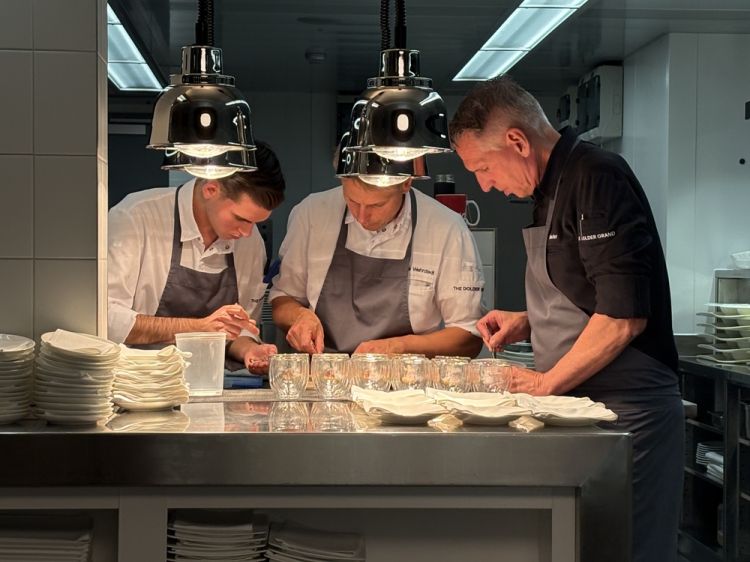
Nieder and his brigade at work: the show within the show, as seen from the Chef’s table
From the very first bites,
Nieder’s cooking reveals consistent technical precision and the pursuit of a light elegance, rich in colour and floral notes. Among the greetings from the kitchen is a tartlet that plays on the idea of foie gras, recreated in a plant-based version with mushrooms and liquorice root, before the
Lobster with melon, bronze fennel, tarragon, coriander and green curry and the
Turbot French dressing show, side by side, two ways of understanding the relationship between the French school and contemporary cuisine.
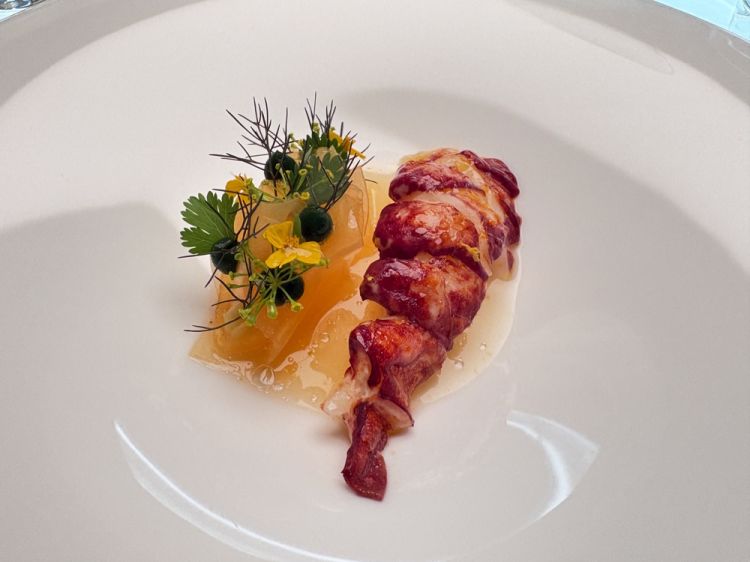
Lobster with melon, bronze fennel, tarragon, coriander and green curry
In the first, a classic ingredient meets the aromas of green curry and coriander, tarragon and fennel, and it is the melon, an element anything but easy to handle, that acts as the link between spices and herbs; the second, more classical in structure despite its contemporary presentation, entrusts to an ingredient of great quality and to impeccable cooking the task of supporting a reinterpretation of the French dressing, whose acidity makes the dish particularly moreish.
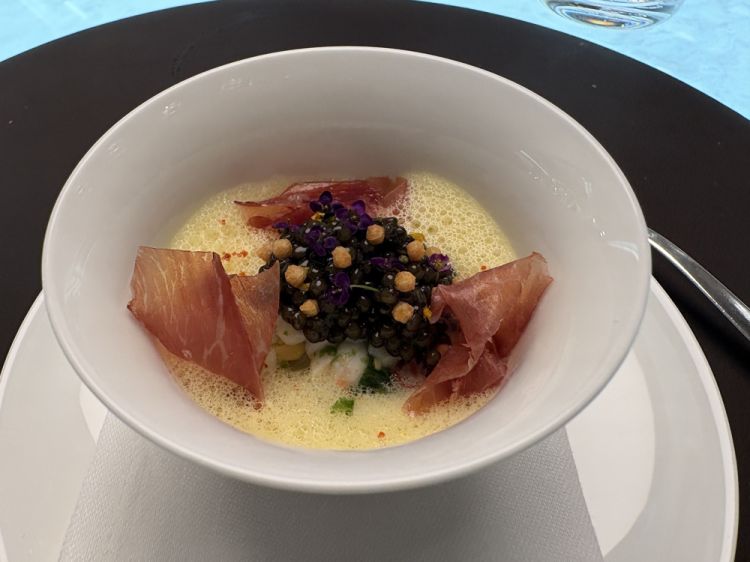
Caviar with king crab, foie gras, corn and Pata Negra
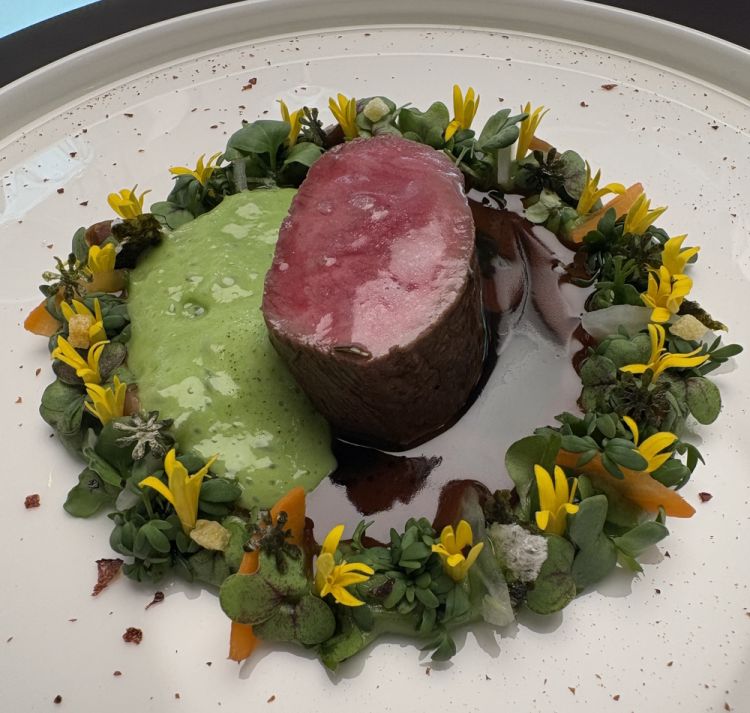
Venison with avocado, garden herbs, seaweed and jalapeño
The
Caviar with king crab, foie gras, corn and Pata Negra, by contrast, captures the spirit of the grand hotel table, bringing together prestigious ingredients in a small, harmonious dish, accompanied by a
Krug Rosé that confirms the care with which the pairings are built. The
Venison with avocado, garden herbs, seaweed and jalapeño stands out for its chromatic composition as well as for its flavour, the
Beef with beetroot, black cumin and blackcurrant, a braised shoulder, for its lightness and for the restraint with which the spices enter the dish without overpowering it, just as in the dessert
White chocolate with cherries, green olives and herbes de Provence we find another exercise in harmonious and surprising balance between elements that on paper seem far apart.
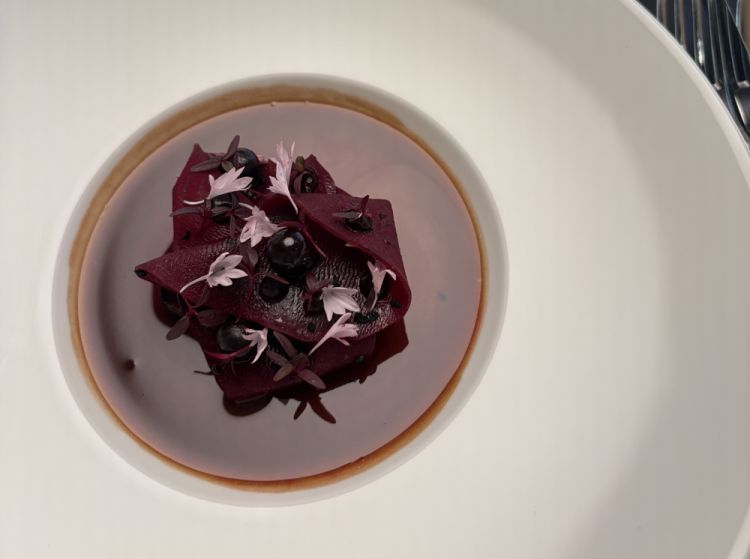
Beef with beetroot, black cumin and blackcurrant
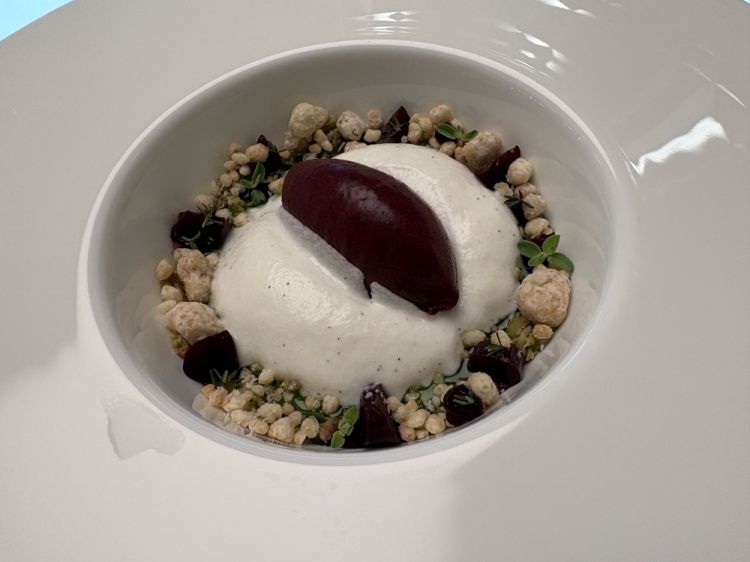
White chocolate with cherries, green olives and herbes de Provence
The same guiding hand can be recognised, in different registers, in the other restaurants. At
Saltz, led since 2016 by
Julian Mai in a dining room designed by the artist
Rolf Sachs, lunch on the veranda, with its open view over the city and the lake, alternates dishes from the Swiss tradition with ones of international scope, prepared with remarkable precision: among the fish courses, the
Black cod with aubergine, pak choi and miso stands out.
In the evening
Saltz also offers the Lebanese cuisine of
Firas El-Borji, who brings in spices and olive oil from his home country:
mezze served on platters in the centre of the table, from which everyone helps themselves as curiosity suggests, and main courses also meant for sharing, with authentic flavours and preparations capable of speaking to a very wide audience. Completing the picture are
Mikuriya, the eight-seat counter where
Atsushi Hiraoka serves a sushi omakase, and
blooms, the plant-based restaurant set in the hotel’s kitchen garden at the edge of the woods, open only in the warmer months.
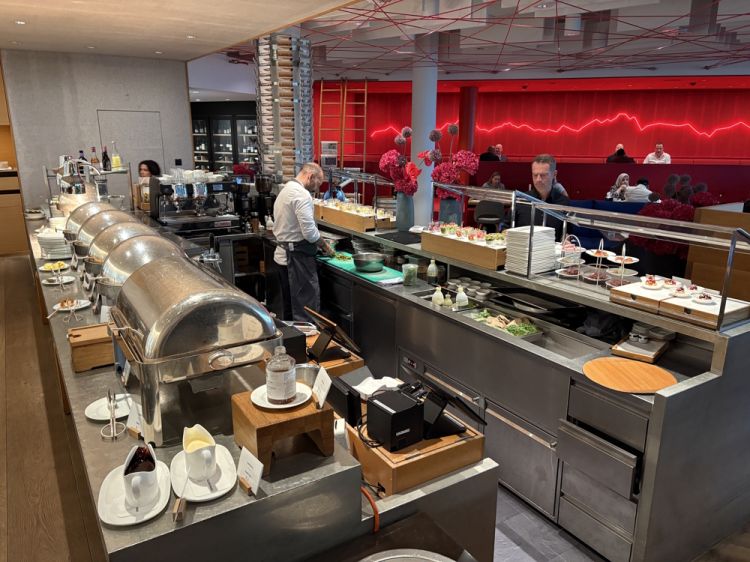
Just part of the breakfast buffets…
And it is again at
Saltz that the day begins, with a breakfast that
Nieder follows with the same attention he devotes to the gastronomic restaurant. Alongside a rich and varied buffet, on both the sweet and the savoury side, the menu offers a number of signature dishes, including the
Onsen egg, named after the Japanese technique of low-temperature cooking associated with hot springs and served with sea trout roe, cured salmon, potato espuma, dill, wasabi and croutons: a dish both indulgent and light, of which the chef is particularly fond, and which brings to the first meal of the day the precision found in the evening at the
Chef’s Table.